The Journey to AI - Part 1
The forgotten history of AI before neural networks — and the pivot that saved everything.
In this article
- The Journey to AI Part 1
- We Tried to Write Intelligence by Hand. It Failed Spectacularly.
- The First Obstacle: Nobody Could Define "Thinking"
- The Four Cracks That Broke Everything
- Crack #1: Brittleness
- Crack #2: The Knowledge Bottleneck
- Crack #3: Common Sense Is Invisible
- Crack #4: Perception Is Inarticulate
- Two AI Winters
- The Escape: Stop Writing Rules Entirely
- What's Next
The Journey to AI Part 1
We Tried to Write Intelligence by Hand. It Failed Spectacularly.
The forgotten history of AI before neural networks — and the pivot that saved everything.
Part 1 of 4 in "The Journey to AI Agents"
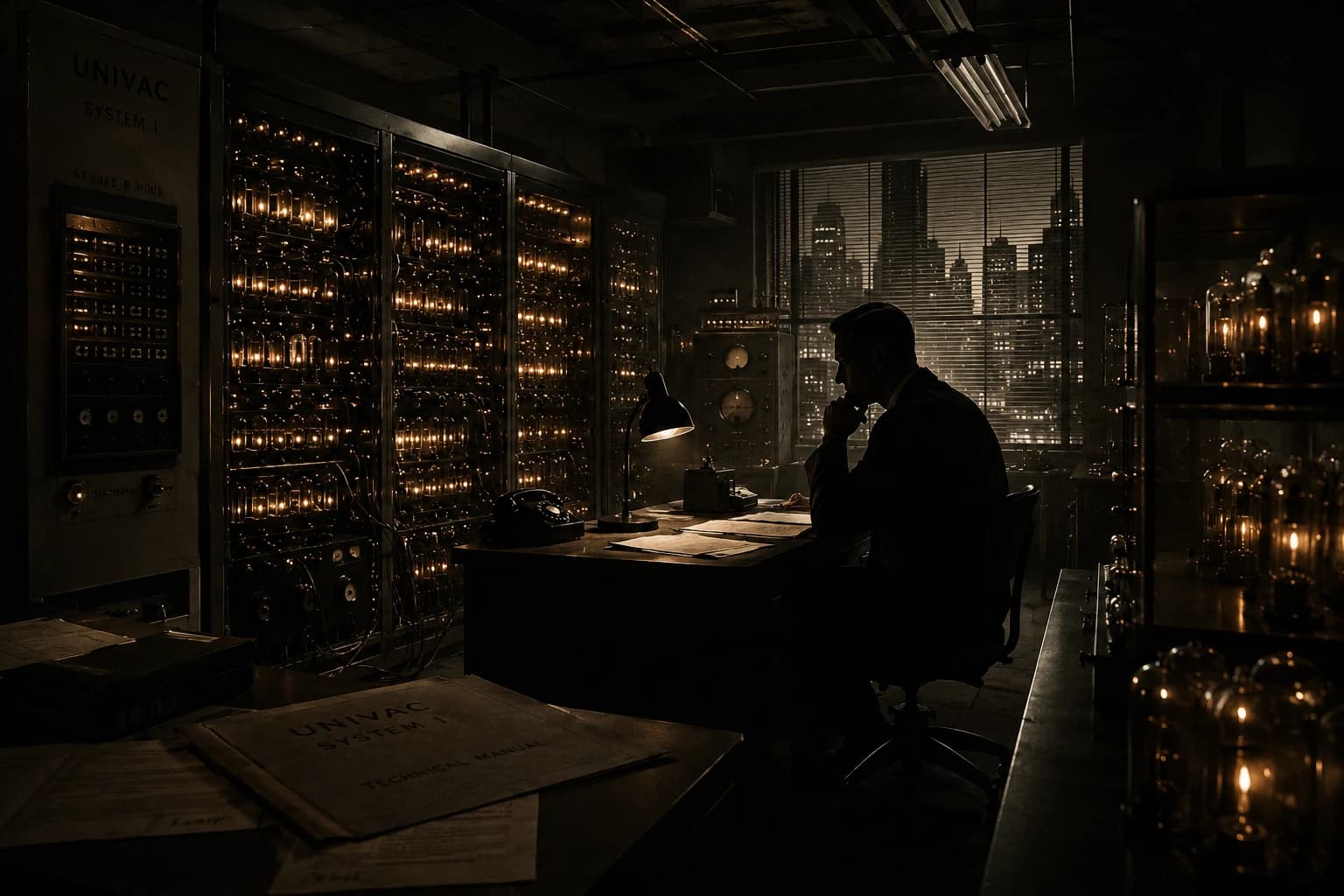
Imagine it's 1950.
World War II just ended. Computers fill entire rooms and run on vacuum tubes. And one mathematician sits down and asks a question that sounds almost philosophical:
"Can a machine think?"
His name was Alan Turing. And in the next few decades, this one question would spark a billion-dollar industry, two complete collapses, and eventually, a revolution that brought us ChatGPT, Claude, and AI agents.
But it didn't start that way.
The First Obstacle: Nobody Could Define "Thinking"
Turing ran into a wall immediately. Before you can build something that "thinks," you need to define what thinking is. And the moment you try, it falls apart.
Does a calculator think when it multiplies numbers? Does a thermostat "decide" to turn on the heat? Does a dog think? What about a sleeping human?
The word was too fuzzy to be useful. So Turing did something brilliant; he replaced the question entirely.
Old question: "Can a machine think?" — unanswerable, too vague.
New question: "Can a machine behave in a way that's indistinguishable from a human?" — testable.
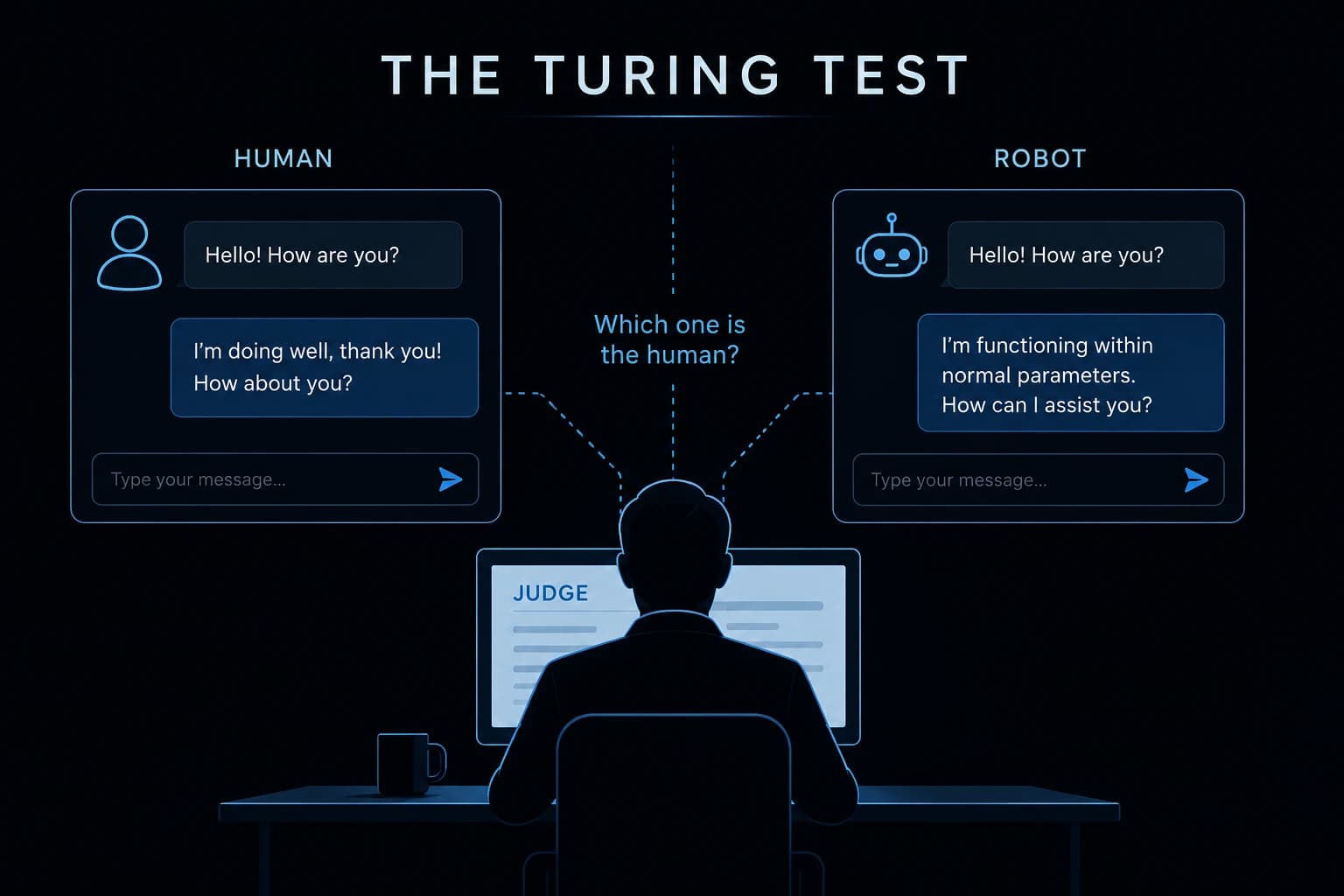
This became the Turing Test: put a human judge in a text chat. On the other side is either a human or a machine. If the judge can't reliably tell which is which, the machine passes.
Notice the shift. He didn't try to solve philosophy. He created a benchmark. Something measurable.
This one decision set the tone for everything that followed: judge by behavior, not by inner experience. You can't measure a soul. You can measure outputs. Every AI system from 1950 to today is judged by this standard.
The First Real Attempt: Write All the Rules Down
Okay. We have a goal. Now how?
Early researchers looked at what seemed like the highest form of human intelligence — chess, mathematical proofs, logical deduction, and arrived at what felt like a profound insight:
Intelligence is the manipulation of symbols according to rules.
Think about how you do math. 2 + 2 = 4. You apply rules to symbols. Logic works the same way:
- Rule: If something is human, then it is mortal.
- Fact: Socrates is human.
- Conclusion (the machine derives this): Socrates is mortal.
The idea: capture enough facts and rules, and the machine reasons its way to intelligent behavior. This was Symbolic AI, sometimes called "Good Old-Fashioned AI" (GOFAI).
And for a while? It was genuinely impressive.
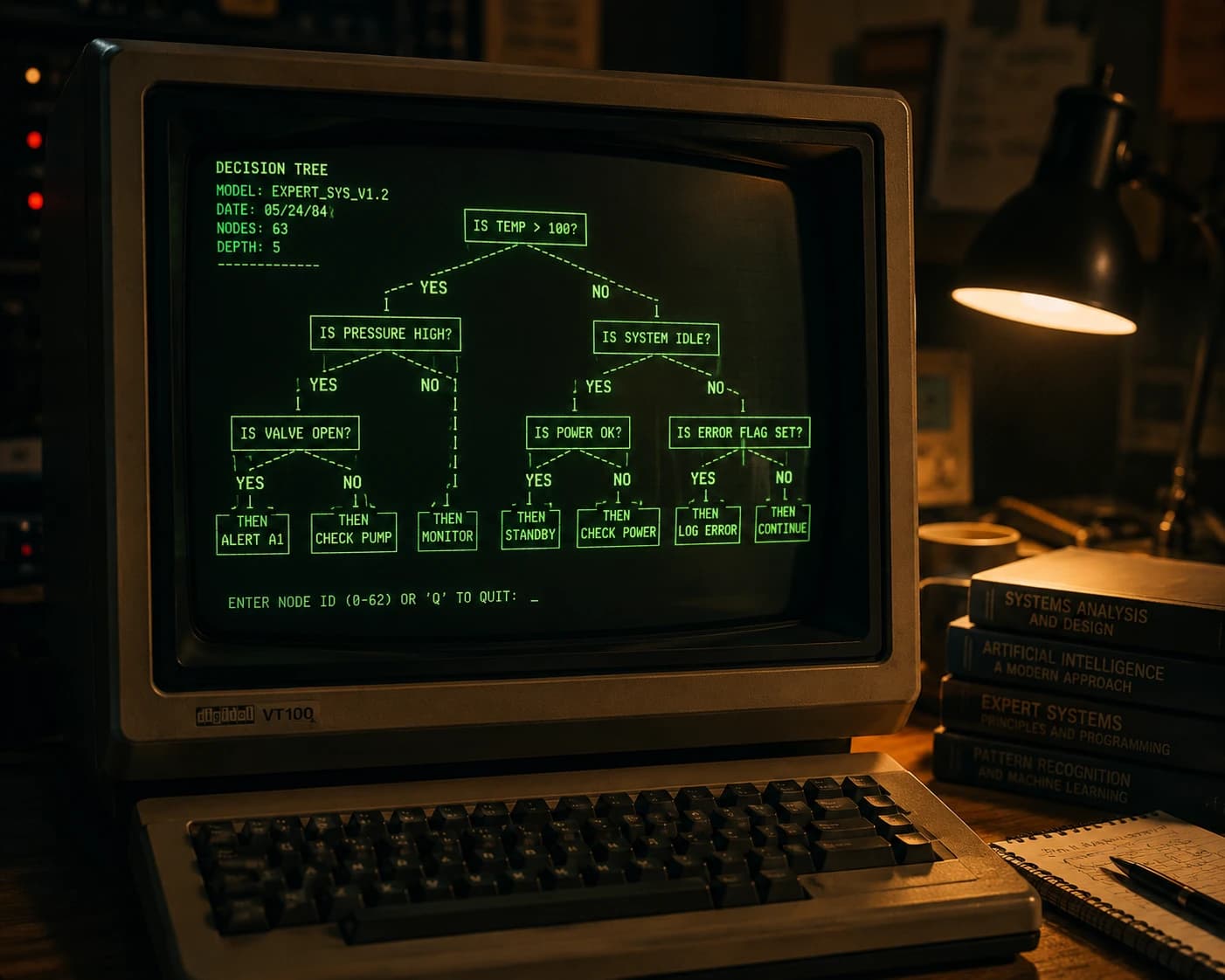
Programs proved mathematical theorems. Others played chess. In the 1980s, MYCIN - an expert system with hundreds of if-then rules written by real doctors diagnosed bacterial infections nearly as well as specialists.
The hype was real. Companies poured millions into it. Governments funded research. Everyone believed they were on the verge of a breakthrough.
The Four Cracks That Broke Everything
Then reality arrived. And it arrived in four brutal lessons.
Crack #1: Brittleness
If X is a bird, then X can fly.
Clean. Logical. Wrong.
Penguins. Ostriches. Dead birds. Baby birds. Injured birds. Caged birds. Every rule needed a thousand exceptions, and every exception needed its own exceptions. Step one inch outside what the rule-writer anticipated, and the system gave you confidently wrong answers.
Crack #2: The Knowledge Bottleneck
Who writes all these rules? Humans. By hand. One at a time.
In the 1980s, the Cyc project set out to manually encode all of human common sense into a computer. They started with the best AI researchers money could buy.
They're still going. Decades later. Millions of rules in. Still nowhere near what a 5-year-old knows without trying.
You simply cannot hire enough people to write down everything humans know.
Crack #3: Common Sense Is Invisible
Most of what you know, you don't know that you know:
- "If I pour water, it falls down, not up."
- "A person in the next room still exists even when I can't see them."
- "If I push a box, the label on it moves with it."
These facts feel obvious. But they're also essentially infinite. And Symbolic AI needed every single one stated explicitly as a rule. Capturing human common sense turned out to be maybe the hardest problem in computer science.
Crack #4: Perception Is Inarticulate
Write the if-then rules for recognizing a cat in a photo. Right now. Go ahead.
IF pointy_ears AND whiskers AND fur THEN cat?
A fox has those. A curled-up sleeping cat shows none of them. You know a cat when you see one, but you genuinely cannot explain how. The same goes for speech recognition, handwriting, and faces.
The things humans find completely effortless, Symbolic AI found them impossible.
Two AI Winters
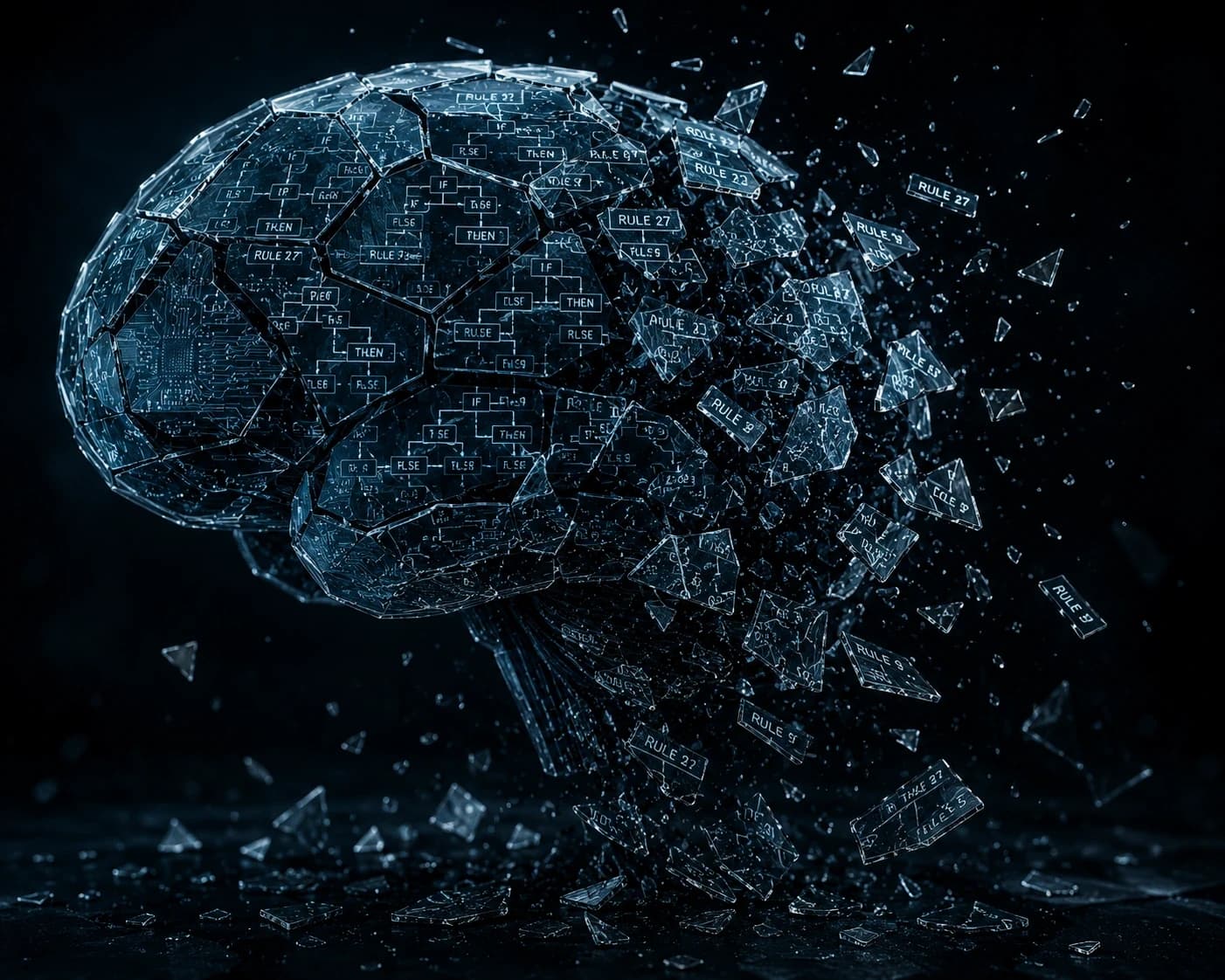
Twice in AI's history, in the 1970s and again in the late 1980s, the promises went unfulfilled, the funding collapsed, and the hype died.
These are called the AI Winters.
Expert systems were expensive to build, expensive to maintain, and brittle in production. Every company that had invested heavily in them was quietly abandoning ship. Universities couldn't get grants. Researchers changed careers.
It looked like AI might be a permanent dead end.
The Escape: Stop Writing Rules Entirely
But look at all four cracks. They share one root cause:
The human has to write every rule.
The moment someone saw that clearly, the obvious question followed:
"What if we just… don't write the rules? What if we show the machine thousands of examples and let it figure the rules out by itself?"
You can't write the rule for "cat." But you can gather 50,000 labeled photos of cats and let the machine find the pattern on its own.
Don't program the knowledge. Learn it from data.
This was the birth of Machine Learning. And it changed everything.
What's Next
The big pivot is set. In the next post, we’ll go inside the mechanics: what does “learning” actually look like in code and math? And how did one artificial neuron, modeled on the human brain, nearly derail the entire field in 1969?
The perceptron awaits.
Part 2: “How a Machine Learns: The Guess→Check→Adjust Loop That Changed Everything”
Tags: Artificial Intelligence, Machine Learning, History of Technology, Programming, Deep Learning
Originally published on Medium on June 24, 2026.
Comments
Coming soon.